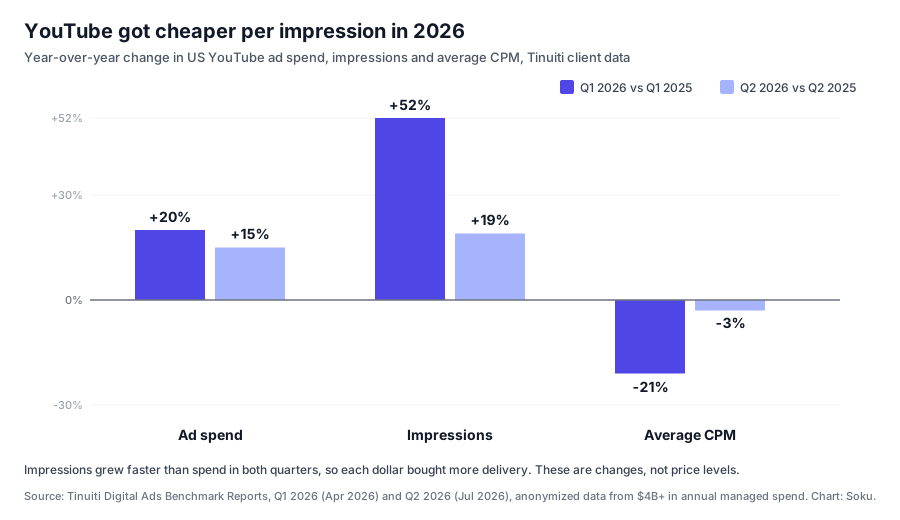
YouTube ads have no price list. You buy them at auction in Google Ads, and depending on the format you pay per 30-second view, per 10-second Shorts view, per click, or per thousand impressions. On the most transparent public dataset we found, AdConversion's analysis of $1,041,978 in YouTube spend (B2B SaaS companies, 2023 to 2024), the average cost per view was $0.05 and the average CPM was $9. Since then, prices have fallen: Tinuiti reports that average US YouTube CPMs dropped 21% year over year in Q1 2026, with a further 3% decline in Q2.
That's the headline. The more useful answer depends on the format, because a bumper ad, a skippable in-stream ad and a Shorts ad charge you on different events. Most pages ranking for "youtube ads cost" give one CPV range and one CPM range for all of them, usually without a sample or a date. This page goes format by format, from Google's own help center: when each one bills, which campaign type buys it, and what that means for a budget. Then it works through budget examples you can rerun on your own numbers.
A note on intent. This is the advertiser's cost, meaning what you pay Google to run ads. If you searched "YouTube CPM" because you run a channel and want to know what you'll earn, that's a different number (creator RPM, after YouTube's revenue share). Nothing below applies to it.
Last verified: 2026-10-14. Every billing rule links to the Google Ads Help article we read that day. Google's help pages we read don't show a "last updated" date, so check the link if you're reading this much later. Benchmarks are third-party estimates, each with its sample, period and caveats. The budget examples are illustrative arithmetic on stated assumptions, not benchmarks. For the cross-platform reference and the figures we refused to publish, see the pillar: paid media benchmarks by industry. The sister pages cover Google Ads (Search) cost, Facebook ads cost and TikTok ads cost.
YouTube ad cost by format: what you pay for, and when
This is the table we couldn't find in one place on any ranking page. It's built from Google's About video ad formats, About YouTube's cost-per-view bidding, Create a Video reach campaign and the Demand Gen FAQ, read on 2026-10-14.
| Format | Where you buy it | How it's billed | The billing event, in Google's words |
|---|---|---|---|
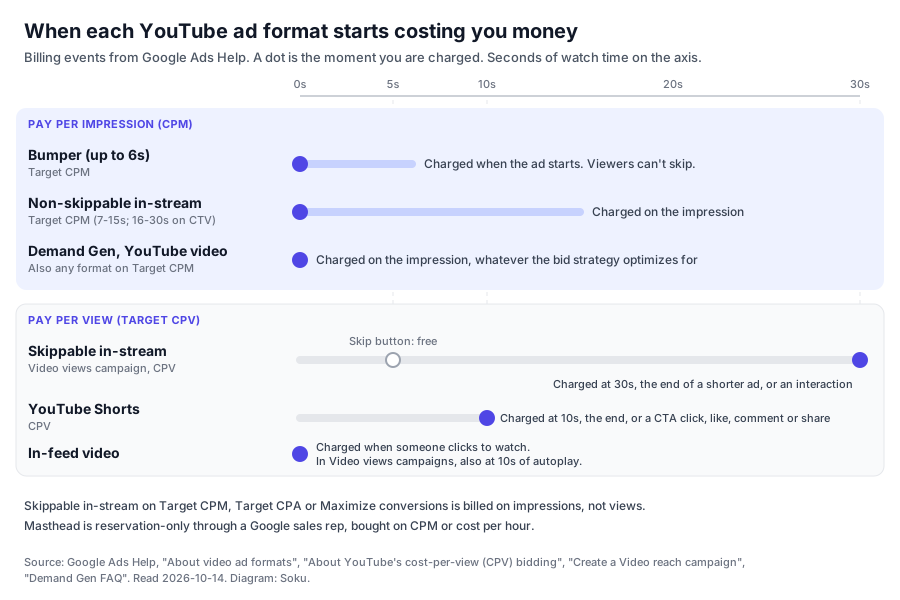
| Skippable in-stream | Video views, Video reach (efficient reach, target frequency) | CPV on Target CPV. Impressions on Target CPM, Target CPA or Maximize conversions | A view is billed when someone "watches 30 seconds of your video ad (or until the end of the ad if it's shorter than 30 seconds)" or interacts with it, whichever comes first |
| Non-skippable in-stream | Video reach (non-skippable reach, target frequency) | Target CPM | "Non-skippable in-stream ads use Target CPM bidding, so you pay based on impressions." Standard length 7 to 15 seconds; a 16 to 30 second version runs on connected TV |
| Bumper | Video reach (all three subtypes) | Target CPM | "Bumper ads use Target CPM bidding, so you pay based on impressions" |
| In-feed | Video views, Video reach | Per click to watch, or per view | "You'll only be charged when someone clicks to watch the ad." In Video views campaigns, also when it autoplays for at least 10 seconds |
| YouTube Shorts | Video views, Video reach | CPV on Target CPV, or impressions on Target CPM | A view is billed at 10 seconds "or until the end of the ad if it's shorter than 10 seconds," or on a CTA click, like, comment or share. On Target CPM, an impression counts when the ad "begins to play in the YouTube Shorts feed" |
| Demand Gen (YouTube video placements) | Demand Gen campaigns | CPM | The Demand Gen FAQ lists "YouTube video: CPM" and "YouTube image: CPM." Other Demand Gen surfaces bill differently (below) |
| Masthead | Reservation through a Google sales rep only | CPM or cost per hour | "You can buy Masthead on Cost-Per-thousand Impression (CPM) or Cost-Per-Hour (CPH)" |
Four things in that table matter more than any benchmark.
The skip button isn't a billing event. Skippable in-stream ads show a skip button after 5 seconds, but on cost-per-view bidding you're charged at 30 seconds, at the end of a shorter ad, or on an interaction. Viewers who skip at 6 seconds without clicking or otherwise interacting cost nothing; an interaction is billed even if the viewer then skips. That makes CPV bidding forgiving of a weak opening, since you only pay for people who stayed. It also means your spend per thousand impressions rises as your ads get better at holding attention, because more of the impressions turn into billable views. That's money buying attention, not waste, so judge it on cost per result.
The same skippable ad can bill two ways. Google's format page says that on Target CPM, Target CPA or Maximize conversions, skippable in-stream ads are billed "based on impressions." So "YouTube costs $0.05 a view" only describes Target CPV campaigns. A skippable ad in a conversion campaign pays for every impression, skipped or not.
Non-skippable and bumper ads never earn TrueView views. Google's CPV article says plainly that bumper and non-skippable in-stream ads "aren't eligible for TrueView views." If a guide quotes a CPV for bumper ads, it's dividing spend by something other than a billable view.
Shorts and in-stream views count on different clocks. A Shorts view counts at 10 seconds, an in-stream view at 30. A Shorts CPV and an in-stream CPV measure different amounts of attention, so the cheaper-looking one isn't automatically the better buy.
Campaign types: which one decides your price
Since Google retired the "Awareness and consideration" name, Video campaigns sit under the objective YouTube reach, views, and engagements (plus Sales, Leads and Website traffic). According to Google's Create a Video campaign article, the bid strategies available for video are Target CPV, CPM, viewable CPM, Target CPA, Target ROAS, Maximize conversions and Maximize conversion value. Manual CPC, Enhanced CPC and Maximize clicks are not.
Video views campaigns: you're buying views
Google's CPV article says "the TrueView cost-per-view (CPV) bid strategy is available when you set up a Video views or Ad sequence campaign," and that in a Video views campaign with multi-format ads, "your bid is TrueView target cost-per-view (tCPV)." Target CPV is an average you're willing to pay. Google says "some views cost more or less than your target," and calls what you're actually charged the "actual CPV." The current article describes a target, not a maximum CPV bid. If an older guide tells you to set a max CPV, it's describing a control your account may no longer show.
A Video views campaign can serve skippable in-stream, in-feed and Shorts ads. Because the in-feed and Shorts view thresholds are lower (a 10-second autoplay or a 10-second Shorts watch), a blended CPV from a Video views campaign isn't comparable with a CPV from in-stream only. Split the report by ad format before you judge it.
Video reach campaigns: you're buying impressions
Google's Video reach article lists three subtypes:
| Subtype | Formats | How you bid |
|---|---|---|
| Efficient reach | Bumper, skippable in-stream, in-feed and Shorts, or an AI-chosen mix. Google says it reaches "more unique users at a lower cost" | Target CPM, auction or reservation |
| Non-skippable reach | Bumper and non-skippable in-stream (7 to 15 seconds, or 16 to 30 seconds on CTV) | Target CPM, auction |
| Target frequency | Bumper, skippable and non-skippable in-stream, in-feed and Shorts | An ad group bid with a built-in suggestion to hit the frequency goal. Goals of 2 to 7 a week or 4 to 12 a month for multi-format ads |
In a reach campaign, the number that matters is cost per unique person reached at your target frequency, not CPM alone. A low CPM bought at frequency 8 can cost more per person reached than a higher CPM at frequency 2. If you run several reach campaigns against one audience, Google's new structure for sharing one reach goal across them is covered in our Video campaign groups guide, and the frequency math in reach and frequency optimization for video ads.
Demand Gen: the campaign that replaced Video action
If you want conversions from YouTube, you're buying Demand Gen. Google's upgrade notice says it removed the option to create new Video Action Campaigns in April 2025, started upgrading existing ones in July 2025, and was "automatically upgrading the final campaigns to Demand Gen by April 2026." Any YouTube cost guide that still prices "Video action campaigns" is describing a product you can't buy.
Demand Gen bills differently by surface. Per Google's Demand Gen FAQ, it "will use mixed billing including CPM and CPC bidding":
| Demand Gen surface | Billing event |
|---|---|
| YouTube video | CPM |
| YouTube image | CPM |
| Discover feed image | CPC |
| Discover video, Maximize clicks | CPM |
| Discover video, other bid strategies | CPC (first physical click) or engaged view, meaning a 10-second watch followed by a click |
| Gmail | "Teaser click," the first click to expand the ad |
| Display network | CPM |
So even with a Target CPA bid, the YouTube video part of a Demand Gen campaign is billed per thousand impressions. Your cost per conversion is spend divided by conversions, and the CPM underneath it is the root of every other number, just as it is on Meta and TikTok. For what changed in Demand Gen this year, see our Demand Gen 2026 guide.
Budgets: what Google actually requires
There's no fixed price and no published minimum. Google's "How much does Google Ads cost?" page (dated September 2026) says Google Ads "has no flat fees or monthly subscriptions." Neither the Video campaign setup article nor the Video reach article we read gives a minimum daily budget. You'll see "YouTube's technical minimum is $10 a day" on ranking pages. We couldn't find that in Google's documentation, so treat it as folklore.
Daily budgets can overspend on a given day, not over a month. Google's budget article says "your campaign might spend up to twice your average daily budget" on a given day, and that "at the end of the month, you will have spent no more than 30.4 times your average daily budget." The Video campaign setup article adds that you'll only be billed up to the amount you set, even if Google serves more views or impressions than your budget allows.
Campaign total budgets work for YouTube flights. For a launch or a fixed-length push, Google's campaign total budgets let you set one total and dates instead of a daily amount. Google lists YouTube support for "tCPM, tCPV (Auction), and Fixed CPM (Reserve)," and Demand Gen too. The minimum period is 3 days, and "for Demand Gen and YouTube, you can align with your time-bound event up to 1 year." Google says "you will never be charged more than your total budget."
The real budget guidance is in Demand Gen's bidding pages. This is where Google does publish numbers, and two of its own pages disagree:
| Google page (read 2026-10-14) | What it recommends |
|---|---|
| About Demand Gen campaigns | "For campaigns using target CPA bidding, Google Ads recommends setting a budget that's at least 10 times your target CPA" |
| Fix Demand Gen campaigns not running: Low budget | "At least 20 times your average target CPA for conversion bidding," or 20 times the expected average conversion value for value bidding |
| Same troubleshooting page | Maximize clicks: "no minimum budget is required," but "a good practice is to use at least $100 USD per day, per ad group" |
| Same troubleshooting page | "A minimum daily budget of at least $100 USD per day, per ad group will help avoid a cold start," and "at least $500 USD per ad group, per day will help drive effective and efficient performance" |
Third-party coverage (PPC News Feed, August 2026) reports that the 10x figure on the overview page replaced an earlier 15x. The troubleshooting page still says 20x. Treat the 10x figure as Google's recommended starting point (a recommendation, not a hard minimum) and the 20x figure as the comfortable number, and don't split a small budget across many ad groups: the $100 per ad group guidance multiplies fast.
What YouTube ads actually cost: the third-party numbers
Google publishes no CPV or CPM averages. Every number in this section is a third-party estimate. We only kept sources that name a sample and a period, and we're showing their faults alongside their numbers.
Price levels: AdConversion's $1.04M B2B dataset
AdConversion, a B2B ad agency, published this in May 2024. The sample is companies with more than $10,000 in YouTube spend, 2023 to 2024 performance, all B2B SaaS, $1,041,978 in total spend. The anonymized dataset is linked from the article.
| Metric (YouTube, B2B SaaS) | Average | Range |
|---|---|---|
| Cost per view (in-stream) | $0.05 | $0.01 – $0.19 |
| CPM | $9 | $1 – $23 |
| Cost per click | $3.56 | $0.05 – $10.71 |
| View rate (in-stream) | 29.24% | 3.47% – 51.39% |
| Click-through rate (in-stream) | 0.51% | 0.09% – 1.64% |
Source: AdConversion, "Insider Benchmarks From $1,041,978 In YouTube Ads Cost Data," published 2024-05-17, read 2026-10-14. Third-party estimate.
Where it breaks:
- It's B2B SaaS only, and small. About a million dollars across an undisclosed number of companies, with a minimum of $10,000 each. Consumer brands buy different audiences at different prices.
- It predates the 2025 to 2026 changes. Video Action Campaigns were still live, and Tinuiti's data below shows CPMs falling sharply since. Treat $9 as a 2023 to 2024 level, not a 2026 one.
- It says "average" without saying which kind. We can't tell whether these are means, medians or spend-weighted figures. The ranges are wide enough (CPM from $1 to $23) that the average alone hides most of the information.
Operator ranges: TNT Growth, 2026
TNT Growth, a growth agency, published ranges from accounts it describes as about $700,000 a month in YouTube spend (published March 3, 2026, updated July 13, 2026). It reports CPV of $0.02 to $0.30, CPM of $4 to $10, and Shorts CPM of $2 to $5. These are ranges from one agency's clients with no count of accounts and no median. Use them as a sanity check on your own account, not as a target.
The direction of travel: Tinuiti, Q1 and Q2 2026
The best-sampled source on YouTube pricing in 2026 doesn't publish price levels at all. It publishes changes. Tinuiti's quarterly Digital Ads Benchmark Report draws on anonymized data from more than $4 billion in annual managed ad spend. The full report is gated, so we've used Tinuiti's own Q1 2026 summary and press coverage of Q2 (The Measure, Karooya).
| US YouTube, year over year | Q1 2026 | Q2 2026 |
|---|---|---|
| Ad spend | +20% | +15% |
| Impressions | +52% | +19% |
| Average CPM | −21% | −3% |
| Shorts share of YouTube video spend | 18% | 17% |
| Share of Shorts spend served on TV screens | 58% | 60% |
Three readings for budget planning:
- More inventory, roughly the same demand. In both quarters impressions grew faster than spend, so the price per thousand fell. If you planned a 2026 budget on a 2024 CPM, you're probably over-estimating cost per impression.
- The decline slowed sharply. −21% in Q1 became −3% in Q2. Don't project the Q1 drop forward into Q4 planning, when auction pressure usually rises.
- The TV screen is now the main YouTube screen. Tinuiti says TV screens took 72% of YouTube video campaign spend in Q1 2026, and even most Shorts spend landed on TVs. If your creative only works on a phone, that's a real cost: you'll pay for living-room impressions your ad wasn't made for.
A caution about combining these sources: it's tempting to take AdConversion's $9 CPM and knock 21% off it. Don't. The samples are different (B2B SaaS versus a broad client base), the periods don't line up, and a year-over-year change in one dataset says nothing precise about the level in another. The honest summary is a direction (cheaper per impression in 2026 than a year earlier) and a rough range from small, named samples.
YouTube ad budget examples (illustrative)
Every number in these examples is an assumption chosen to make the arithmetic easy to follow. None is a benchmark and none comes from a real account. Where an assumption sits near a published figure, we say which one, but it's still an assumption. A monthly figure uses Google's 30.4 days.
Example 1: a Video views campaign on $1,500 a month
Skippable in-stream and Shorts ads in one Video views campaign, Target CPV.
Daily budget            = $1,500 ÷ 30.4                = $49.34 a day
At an assumed $0.05 CPV  (AdConversion's B2B average)  = 30,000 billable views a month
At an assumed $0.02 CPV  (low end of TNT Growth range) = 75,000 billable views a month
At an assumed $0.19 CPV  (top of AdConversion range)   = about 7,900 billable views a month
The spread is the lesson. The same budget buys between roughly 8,000 and 75,000 views depending on audience and creative, so a benchmark CPV can't tell you what your $1,500 will buy. Your first two weeks of data can. And remember the mix: if most of those views are 10-second Shorts views, the cost per 30 seconds of attention is higher than the blended CPV suggests.
Example 2: a bumper reach campaign on $1,000 a month
Efficient reach or non-skippable reach, Target CPM, six-second bumpers.
At an assumed $9 CPM    = $1,000 ÷ $9 × 1,000   = about 111,000 impressions
At an assumed $4 CPM    = $1,000 ÷ $4 × 1,000   = 250,000 impressions
Unique reach at an assumed average frequency of 3:
  $9 CPM                = about 37,000 people
  $4 CPM                = about 83,000 people
Google's reach forecasts (in campaign setup and Reach Planner) account for your actual audience, so use them over this arithmetic once you have one. The point of the example is the frequency term. If your goal is three exposures per person, every person reached costs three impressions.
Example 3: a Demand Gen conversion campaign
One ad group optimizing for purchases, Target CPA, an assumed $40 target CPA.
Google's overview page:  10 × $40              = $400 a day
Google's troubleshooting: 20 × $40             = $800 a day
Per-ad-group cold-start guidance               = $100 a day recommended (already met)
Monthly at the 10x guidance: $400 × 30.4       = $12,160
Monthly at the 20x level: $800 × 30.4          = $24,320
Expected conversions at a $40 CPA, 10x level   = about 304 a month
Now suppose you only have $3,000 a month, about $98.68 a day. That's under 2.5 times a $40 CPA, well below either Google figure, and just under the $100 per ad group that Google recommends to avoid a cold start. The campaign will run, but by Google's own guidance it is likely to learn slowly on purchases, if at all. You have three options: optimize for a cheaper, more frequent conversion (for example, add to cart) until volume builds, raise the budget, or accept that the account is buying reach and judge it on a different measure.
Example 4: what CPV can you afford?
A Video views campaign isn't optimized for conversions, but you can still check whether it pays. The break-even CPV is the most you can pay per view and still hit your cost per conversion.
Break-even CPV = target cost per conversion × conversions per view
Assumed target cost per conversion   = $40
Assumed conversions per billable view = 0.1% (1 in 1,000)
Break-even CPV                        = $40 × 0.001 = $0.04
At an assumed $0.05 CPV, that campaign loses money on direct conversions. It might still be worth running for reach or remarketing lists, but that's a separate decision, and you should make it on purpose. Count only conversions you can attribute with a window you trust. View-through conversions on YouTube can flatter this number.
You can plan the multi-channel version, with best, base and worst cases, in the paid media budget planning spreadsheet, or turn a CPA and a goal into a budget with the ad budget calculator.
What moves your YouTube cost
The auction decides your price, and the auction responds to things you control. Each item below is either documented by Google or follows from the billing rules above.
| What changes | Effect on cost | Why |
|---|---|---|
| Better hold in the first 30 seconds (Target CPV) | More spend per thousand impressions, more attention per dollar | More impressions cross the 30-second line and become billable views. Judge on cost per result, not on spend per impression |
| Moving a skippable ad from Target CPV to Target CPA | You start paying for every impression, including skips | Google bills skippable ads on impressions under Target CPA and Maximize conversions |
| More Shorts in a Video views campaign | Blended CPV can fall | Shorts views count at 10 seconds instead of 30. That's a measurement change, not a saving |
| Narrow audience (remarketing, customer match) | Often a higher CPM | Fewer eligible impressions for the same competition |
| Q4 and big retail events | Often a higher CPM | More advertisers bid on the same inventory. Tinuiti's 2026 data shows the year-over-year price drop flattening from Q1 to Q2 |
| Higher frequency goal | Higher cost per person reached | Each person needs more paid impressions |
| Many ad groups on a small Demand Gen budget | Slower learning, higher early CPA | Google recommends at least $100 per ad group per day |
| A frequent stream of new creative | Lower cost per result over time | Fatigued creative loses attention, and on CPV it stops producing billable views. See creative fatigue benchmarks |
You can check your own chain with the CPM calculator and CPC calculator. The Google Ads cost calculator is built on Search CPCs, so use it for Search budgets, not for YouTube.
The full cost of YouTube ads is more than media

Photo: Jakob Owens on Unsplash.
Media is what this page has measured, but it's rarely the biggest line for a new YouTube advertiser.
- Video production. Every video format needs video (Demand Gen's YouTube image placements are the exception and can run image creative), and the formats need different cuts: a 6-second bumper, a 15-second non-skippable, a 16 to 30-second version for connected TV, a vertical Shorts cut, and a skippable version that makes its point before the skip button. One shoot rarely covers all of them. AI video tools cut the cost of variations; our best AI video ad generators roundup compares them.
- A YouTube upload for every ad. YouTube video ads run from videos hosted on YouTube, so someone has to manage a channel's uploads, visibility settings and naming as part of the ad workflow.
- Measurement. If you're judging YouTube on last-click conversions, you'll undervalue it. If you're judging it on view-through conversions, you may overvalue it. Brand lift studies and holdout tests cost time and budget too.
- Management. Someone has to watch format mix, frequency, CPV by format and Demand Gen learning. At small budgets an agency retainer can exceed the media spend. See what an AI marketing agency costs.
If you're deciding between YouTube Shorts and TikTok or Reels for short-form creative tests, our Shorts vs TikTok and Reels comparison covers the creative tooling and measurement differences.
What we left out, and why
| What we found | Why we cut it |
|---|---|
| A "$0.024 average CPV," "$11.42 in-stream CPM," "$4.85 Shorts CPM" and "$16.20 CTV CPM" for Q1 2026, quoted by several ranking pages | The original publisher, Digital Applied, now says on its own page that it withdrew those tables because it "could not substantiate" them from the cited sources. Pages still quoting them are quoting a retracted source |
| Industry CPV and CPM tables (e.g. Healthcare $0.071, Automotive $2.90 CPM) on a 2026-dated benchmark page | The page's methodology describes 2024 client data from Search campaigns, the figures match a 2018 agency table, and no sample size is given |
| Industry, age, gender and month CPV breakdowns attributed to Strike Social | From a 2018 report. Too old for 2026 planning. Strike Social's 2024 and 2025 reports are gated and publish no figures on their landing pages |
| "$9.29 average CPM from $14.3B in spend" | Widely repeated, but we couldn't find the primary study, its period or its method |
| "YouTube's technical minimum is $10 a day" | Not in any Google Ads Help article we read |
| "Shorts CPV $0.10 to $0.30" | Blended from several sources with no period or sample. Also compares a 10-second view with 30-second views |
| A "median CPV $0.05, CPM $7.50" percentile table | The page lists general marketing sources (Search, Meta, email) as its data, none of them YouTube-specific |
| CPM figures for bumper ads framed as CPV | Bumper and non-skippable ads aren't eligible for TrueView views |
| Creator CPM and RPM figures | A different question: what channels earn, not what advertisers pay |
| Any Soku account data | We don't publish customer data. Every number here is from Google's documentation, a named third party, or labeled illustrative math |
How Soku fits
The format table tells you what Google charges for. Your account tells you whether it's worth it: CPV by format rather than blended, how many viewers reach 25%, 50% and 100% of each ad, whether a Demand Gen ad group is budgeted below Google's own recommendation, and whether this month's cheaper CPM came from Shorts and TV screens rather than better targeting. That's quick to check once and tedious to check every week.
Soku is an AI agent for paid media that connects to your Google Ads account alongside Meta, TikTok and ChatGPT Ads. For YouTube, it reads spend, impressions, CPM, TrueView views, average CPV and quartile watch-through by ad, so you can ask why cost per view rose or which video is paying for views that never convert, and get an answer from your own numbers rather than a published average. On the write side, Soku can change a Google campaign's budget, status and bid strategy, and register an existing YouTube video as an asset for Performance Max. It doesn't build YouTube Video campaigns from scratch today. Every change goes to a review card first, and nothing is written until you approve it. The exception is an action you've given a standing "Always allow" grant, which you can see and revoke under Settings → Auto Approvals. When the fix is fresher video, Soku Creatives can generate new image and video variations.
Frequently Asked Questions
How much do YouTube ads cost in 2026?
There's no set price. YouTube ads are sold at auction inside Google Ads, and you pay per view, per impression or per click depending on the format and bid strategy. The best-documented public dataset we found, AdConversion's analysis of $1,041,978 in B2B SaaS YouTube spend from 2023 to 2024, reports an average cost per view of $0.05 (range $0.01 to $0.19) and an average CPM of $9 (range $1 to $23). Prices have moved since then: Tinuiti reports that US YouTube CPMs fell 21% year over year in Q1 2026 and 3% in Q2 2026.
How much does YouTube charge per view?
Only skippable in-stream, in-feed and Shorts ads can be bought per view. On skippable in-stream ads, Google charges when someone watches 30 seconds, watches to the end of a shorter ad, or interacts with it, whichever comes first. Skipping at 5 seconds without interacting costs nothing. On Shorts, the threshold is 10 seconds or the end of a shorter ad, or a call-to-action click. AdConversion's 2023 to 2024 B2B dataset averaged $0.05 per view. Bumper and non-skippable ads are never billed per view.
Is there a minimum budget for YouTube ads?
Google's help pages we read on 2026-10-14 don't state a minimum budget for Video campaigns, and Google says it has no flat fees or monthly subscriptions. The practical minimums are in the bidding guidance. For Demand Gen with Target CPA, Google recommends a budget of at least 10 times your target CPA on one help page and at least 20 times on another, plus at least $100 a day per ad group to avoid a cold start.
Do you pay if someone skips a YouTube ad?
Not on cost-per-view bidding. A skippable in-stream ad on Target CPV is only billed at 30 seconds of watch time, at the end of a shorter ad, or on an interaction, so a viewer who skips at 5 seconds without interacting is free. If the same skippable ad runs on Target CPM, Target CPA or Maximize conversions, Google bills on impressions instead, so you do pay for viewers who skip.
Are YouTube Shorts ads cheaper than regular YouTube ads?
Per impression, the sources that publish a Shorts figure put it lower: TNT Growth's 2026 operator ranges show Shorts at roughly $2 to $5 CPM against $4 to $10 for broader YouTube inventory. Per view, comparisons are misleading because a Shorts view counts at 10 seconds and a skippable in-stream view at 30. Compare cost per result, not cost per view, across the two.
What is a good CPV for YouTube ads?
A good CPV is one below your break-even CPV, which is your target cost per conversion multiplied by the share of views that convert. If a customer is worth $40 to you and 1 in 1,000 viewers converts, you can afford $0.04 per view. As a reference point only, AdConversion's B2B dataset averaged $0.05, and TNT Growth reports $0.02 to $0.30 across its client accounts.
Is YouTube CPM the same as what creators earn?
No. This page covers the advertiser's cost: what you pay Google per thousand impressions or per view. Creator-side figures such as RPM or 'YouTube CPM' in YouTube Studio describe what a channel earns from ads shown on its videos, after YouTube's share, and they aren't a guide to what an advertiser will pay.
Related reading
- Paid media benchmarks by industry: the pillar, with sourced cross-platform benchmarks and what we discarded
- How much does Google Ads cost, how much do Facebook ads cost and TikTok ads cost: the same method applied to Search, Meta and TikTok
- Google Video campaign groups: one reach and frequency goal across several YouTube campaigns
- YouTube Shorts vs TikTok and Reels: where short-form creative tests belong
- Google Demand Gen 2026: the campaign type that replaced Video action
- Ad budget calculator: turn a CPA and a goal into a budget